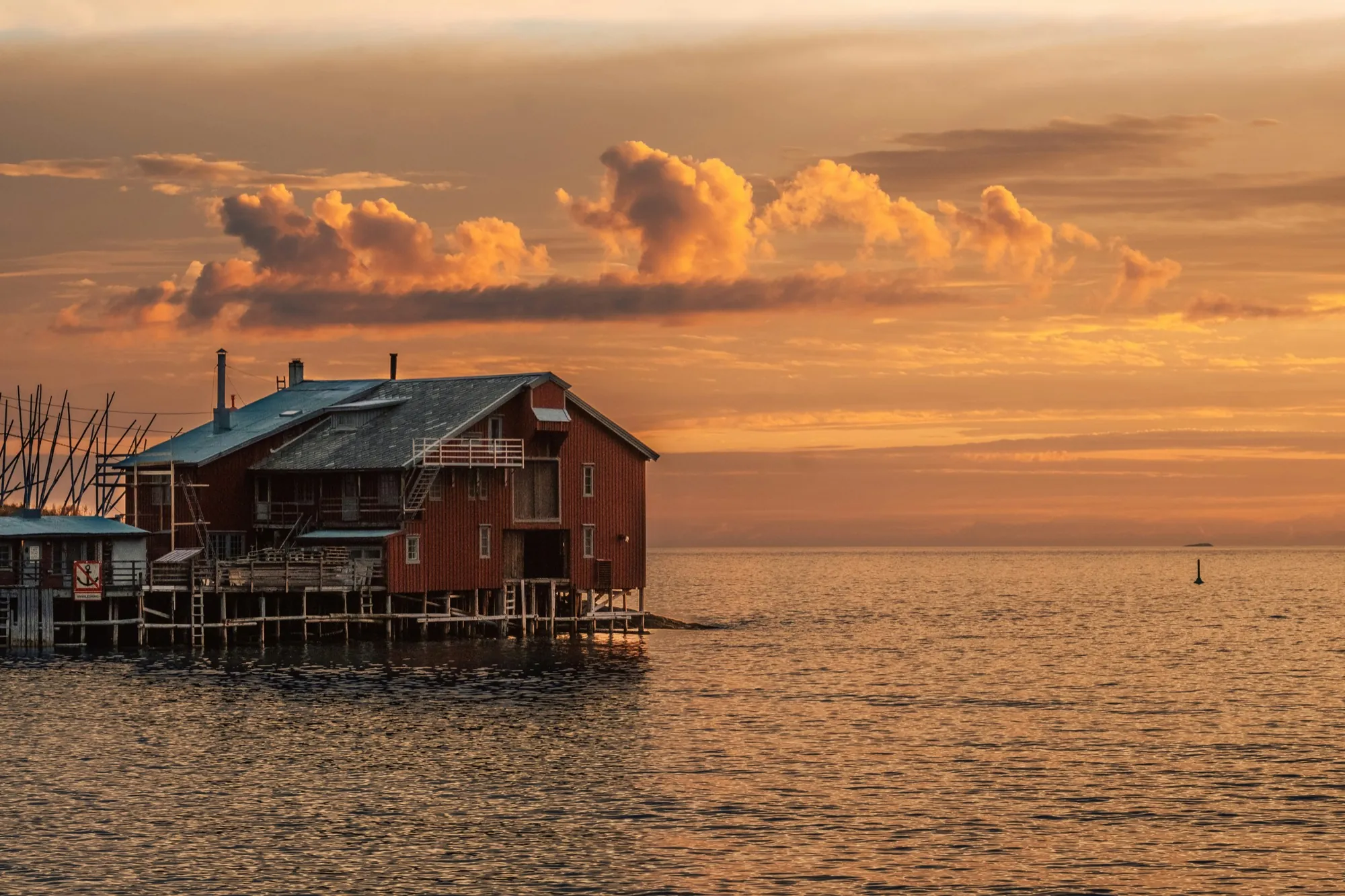
The famous version of the midnight sun involves a hotel rooftop, a crowd of people with cameras, and a scheduled departure time. There is another version, on an empty fjord at eleven o'clock at night, where the light does something to you that is difficult to explain afterwards.
Every summer, thousands of people travel to Tromsø specifically to see the midnight sun. It is a reasonable destination for it — Tromsø is above the Arctic Circle, the sun does not set from late May to late July, and there are cable cars and boat tours and organised events built around the occasion. You can absolutely have a midnight sun experience in Tromsø.
What you are less likely to have, in Tromsø in July, is the experience of being genuinely alone with it.
What the light is actually like
The midnight sun is not the same as daytime sun. This is the thing that surprises people most when they see it for the first time. At midnight — or one in the morning, or two — the sun is very low on the horizon. The light it produces is raking and golden, hitting things from a very flat angle, skimming across the surface of the water rather than striking it from above. Shadows are long. Colour is amplified. Everything looks different.
Mountains that look solid and grey in the afternoon look amber and pink at midnight. Still water goes a colour that photographs badly — some shade of molten metal that cameras render as ordinary orange but that, seen directly, seems to come from inside the surface rather than reflect off it. The sky can be every colour at once. It is not a sunset, because the sun does not set. It is the sun moving slowly around the horizon, throwing its light at a low and oblique angle all night long.
The effect depends enormously on where you are when you see it. From a hotel window or a city viewpoint, you are still in a city. The building opposite is still there. There are still cars. The light is extraordinary but the context is ordinary, and the context matters more than people think.
Why the fjord changes everything
On the water, the context disappears. There are no buildings, no roads, no other people. There is the boat, the fjord, the mountains on all sides, and the sky — which, in the small hours of a clear night in late June, is doing something astonishing. The light lands on the peaks of Senja and turns them colours you have not seen before. It lands on the water and the water holds it. There is no wind at this hour. The fjord goes flat and still.
The silence is part of it. Not complete silence — water moves, birds call — but the absence of the background noise of human activity that you carry around with you most of your life without noticing. Out there it is gone, and you notice its absence.
People on our midnight sun cruises often go quiet for long stretches. Not because there is nothing to say, but because talking feels like the wrong response. The right response, it turns out, is to sit still and let it happen.
Where we go
We depart Finnsnes harbour in the evening — typically around 10 or 11pm — when the town has gone quiet and the fjord belongs entirely to the boat. We head into the open water between Finnsnes and Senja, where the mountains frame the horizon in every direction. Your guide will find the positions where the light is best — there are places where a particular cliff catches the gold just so, and places where a straight channel creates a corridor of reflected light on the water that goes on for kilometres.
The cruise runs three to four hours. We carry hot drinks. You do not need to do anything except be there.
The Midnight Sun Cruise runs from late May to mid-July, departing Finnsnes harbour in the evening. Private groups only.
About this tour