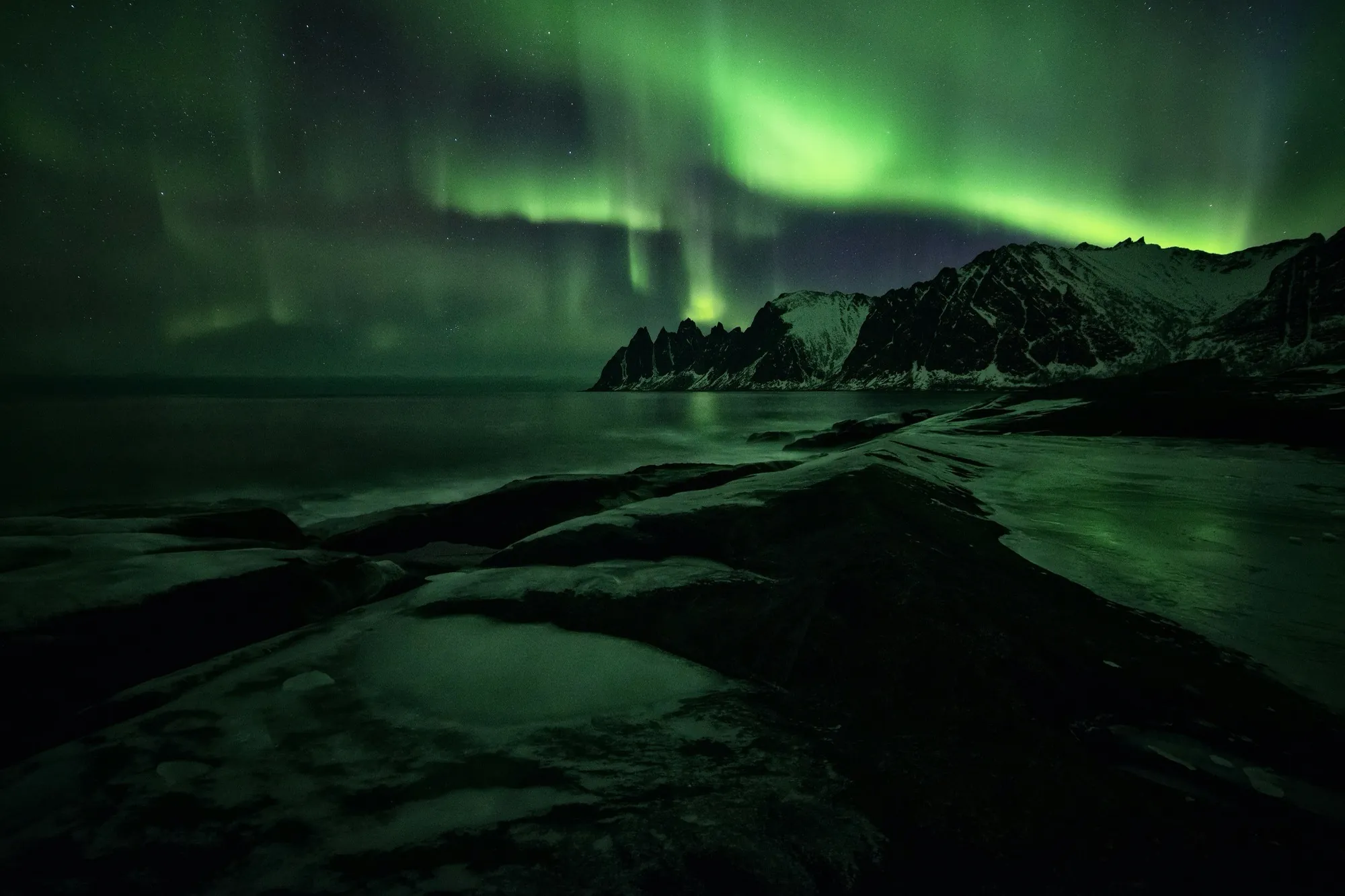
Almost every guide to northern lights photography starts the same way: find somewhere dark, set up a sturdy tripod, open the shutter for fifteen seconds. On a boat, only the first one still holds — and it holds better than anywhere.
The fjord is about as dark as it gets in northern Norway. There are no streetlights on the water, no houses behind you, no headlights coming round the bend. That is the reason to be out there. But a boat is never completely still, even with the engine off on a flat calm night. It breathes with the water. And a fifteen-second exposure records every one of those breaths as a smear.
So the advice changes. Not much, and not in a way that makes things harder — mostly it means unlearning one habit and leaning on a few others.
Why land-based aurora advice doesn't work on a boat
On land, the camera is fixed and the sky is the only thing that moves. Long exposures gather a lot of light, so you can use a lower ISO and get cleaner files. On deck, the camera moves too. A tripod does not fix this; it stands on the deck and moves with the hull, just more rigidly. Exposures beyond a few seconds turn the stars into short squiggles and the mountains along the shore into double outlines.
The fix is to make each exposure short enough that the boat barely moves during it, and to make up the light elsewhere: a wider aperture and a higher ISO.
The good news: strong aurora wants short exposures anyway
Here is the part most land guides leave out. When the aurora is really going — curtains rippling, coronas opening overhead — it moves fast. A fifteen-second exposure blurs all that structure into a soft green wash. Photographers who chase big displays deliberately drop to one or two seconds to keep the shapes sharp.
On a boat you are pushed into that technique from the start. The nights when you most want a good photo are the nights the boat's constraints suit best.
Camera settings for the northern lights on a boat
These are starting points, not rules. Take a test shot, look at the screen, and adjust.
- Mode: manual. Auto exposure will hunt in the dark and get it wrong.
- Aperture: as wide as your lens goes — f/1.4 to f/2.8 is ideal. A kit lens at f/3.5 or f/4 still works; push the ISO a little further.
- Shutter speed: 1 to 4 seconds. Start at 2 and go shorter if the stars look stretched, longer only if the water is glassy.
- ISO: 3200 to 6400. Modern cameras handle this better than people expect, and noise is easier to fix later than blur.
- Focus: manual, set to infinity. Most lenses focus slightly past the infinity mark, so focus on a bright star or a distant light on shore using the zoomed-in live view, then leave the ring alone. A strip of tape helps.
- Lens: the widest you have. 14–24mm on a full-frame camera lets you fit sky, mountains and reflection into one frame.
- White balance: around 3500–4000K, rather than auto, so the colour stays consistent from shot to shot.
- File format: RAW. It gives you room to lift shadows and correct colour afterwards.
- Stabilisation: leave it on. Usual advice is to turn it off on a tripod, but on a boat you are effectively hand-holding.
- Burst: take three or four frames at a time. One of them usually catches the boat at the still point of its roll.
Northern lights on your phone: iPhone and Android
You do not need a camera bag to come home with good aurora photos. Recent iPhones and Android phones are genuinely good at this, and on a boat they have one advantage: their night modes are designed for hand-held shooting.
- Turn the flash off. It lights up the rail and nothing else, and it ruins everyone else's night vision.
- Use night mode, but keep it short. If your phone lets you choose the length, pick a few seconds rather than the maximum. The longest settings assume a tripod.
- Brace the phone. Rest it on the cabin roof, the rail, or against your knee. Hold your breath while it counts down.
- Tap to focus on something distant, such as a light on the shore, before you shoot.
- Turn the screen brightness down. A bright screen kills your eyes' adaptation to the dark, and it takes twenty minutes to get it back.
Do not be surprised when the phone shows more colour than you can see. A sensor collecting light for several seconds picks up green and red that the eye cannot register in the dark. On a faint night the sky may look pale grey to you and bright green on the screen. On a strong night, both will agree.
Holding still without a tripod
The steadiest point on a small boat is low down and close to the middle. Wedge yourself in rather than standing free. Rest the camera on something solid — the cabin roof, the rail, a folded jacket, a small bean bag — and use a two-second self-timer so pressing the shutter does not shake it. If the water is calm, wait for the moment between swells; you will feel it after a few minutes.
Use the water
This is the shot you cannot get from a car park. On a still night the fjord turns into a mirror and the aurora appears twice: once overhead and once in the black water below. A little movement on the surface softens the reflection into streaks of green, which can look better than a perfect mirror. Include the shoreline mountains for scale, and keep the horizon level — it is the first thing the eye checks.
Cold, batteries and condensation
Cold drains batteries fast. Bring a spare and keep it in an inside pocket, close to your body, and swap them when the first one fades — it often comes back to life once it warms up. Thin liner gloves under a warmer pair let you work the buttons without exposing bare fingers.
The bigger risk comes at the end of the night. A cold camera carried straight into a warm room fogs up inside and out. Put it in a sealed bag or a closed camera bag before you go indoors and let it warm up slowly. Salt spray happens too; carry a dry microfibre cloth and wipe the front of the lens now and then.
Remember to look up
The best aurora nights are often the ones people remember least, because they spent them looking at a screen. Take your test shots early, settle on settings that work, and then put the camera down for a while. Some of the most striking displays last only a few minutes. You will want to have seen them.
Quick answers
Can you photograph the northern lights from a boat?
Yes. The boat is never completely still, so keep exposures short — roughly 1 to 4 seconds — and make up the light with a high ISO and a wide aperture. With the engine off on a calm fjord, sharp aurora photos are very achievable, and the reflection in the water is a bonus you rarely get on land.
What camera settings should I use for the northern lights on a boat?
A good starting point is manual mode, the widest aperture your lens allows (f/1.4 to f/2.8), ISO 3200 to 6400, a shutter speed of 1 to 4 seconds, focus set manually to infinity, white balance around 3500–4000K, and RAW files. Leave image stabilisation on if you are hand-holding.
Should I bring a tripod on a northern lights boat trip?
It helps less than you think. A tripod on deck moves with the hull, so it does not give you the long exposures it would on land. Bracing the camera against the rail or cabin roof, or using a small bean bag, works just as well and is quicker to move.
Can you photograph the northern lights with a phone?
Yes. Recent iPhones and Android phones capture the aurora well in night mode. Turn the flash off, brace the phone against something solid, and keep the night-mode time short — a few seconds — so the boat's movement does not blur the shot.
Why does the aurora look brighter in photos than to the eye?
A camera sensor collects light over seconds and picks up colour that the eye cannot see in the dark. Faint aurora often looks pale grey or whitish to the naked eye and green on the screen. Strong displays are vivid to both.
On our Northern Lights Cruise the skipper helps you set up your phone or camera before the lights arrive, and photographs your group under the aurora — the photos arrive the next day. A private boat for up to five, from Finnsnes at 20:30, October to March. Check the aurora outlook for the next few nights.
See the Northern Lights Cruise